
Order: Tetraodontiformes (L.S. Berg,1940)
General
- Also known as pufferfish. Represented by 10 families, with approximately 430 species
- Highly Derived ray-finned fish, also called Plectognathi
- No close relatives. Descend from a line of coral dwelling species that emerged 40 million years ago
- Various bizarre forms of bodies, all radical departures from the streamlined body typical of most fish.
Distinguishing Characteristics
- Are distinguished by their small mouths with unusual dentition. Modified teeth that may be enlarged or fused into a beak-like structure, or incorporated into the jaw bones
- Many have a thick spiny skin, Scales are often modified into spines, ossicles or fused bony plates.
- Ability to inflate their bodies with water or air up to three times their original size.
- Have fewer bones than other fish.
- Have fewer dorsal and pelvic fin spines than other fish, No anal fin spines.
- Have rounded bodies that are often tapered at the mouth and tail.
- Produce toxins to defend themselves from predators.
- The gill opening is reduced to a small slit near the pectoral-fin base,
Distribution
- Most are marine and dwell in and around tropical coral reefs
- Species share the loss, reduction or fusion of many bony structures in the head and body. Fins and their supporting elements are reduced or lost, and vertebrae are reduced in number.
Separated into 3 Suborders and 10 Families
Suborder: Balistoidei
Family: Aracanidae Deep Sea or Temperate Boxfishes Hollard, 1860
Family: Balistidae Triggerfish Rafinesque, 1810
Family: Monacanthidae Filefish Nardo, 1843
Family: Ostraciidae Boxfish Rafinesque, 1810
Suborder: Tetraodontoidei
Family: Diodontidae Porcupinefish Billberg, 1833
Family: Molidae Molas or ocean sunfishes Bonaparte, 1832
Family: Tetraodontidae Pufferfish Bonaparte, 1831
Family: Triodontidae Threetooth puffer Bleeker, 1859
Suborder: Triacanthodoidei
Family: Triacanthidae Triplespines or Tripodfishes Bleeker, 1859
Family: Triacanthodidae Spikefishes Gill, 1862
Suborder: Balistoidei
Family: Aracanidae Deep Sea or Temperate Boxfishes Hollard, 1860
General
- includes the pufferfishes, triggerfishes and ocean sunfishes
Distinguishing Characteristics
"A small family of oval to round fishes with bodies almost completely encased in a bony carapace formed from large thickened scale plates, usually hexagonal in shape and firmly sutured to one another; except the caudal peduncle which has isolated plates to allow tail movement.
All species have very small mouths and often locate their invertebrate prey by blowing a jet of water onto the sediment. See Matsuura 2014.
Boxfishes lack fin spines and pelvic fins, and the short-based dorsal and anal fins are set far back on the body.
The rigid plates end before or on the tail base which is never completely enclosed in fused plates. The carapace has a series of longitudinal ridges, including a ventral ridge, and bear large fixed spines in some species. Bray, Dianne J. 2025”
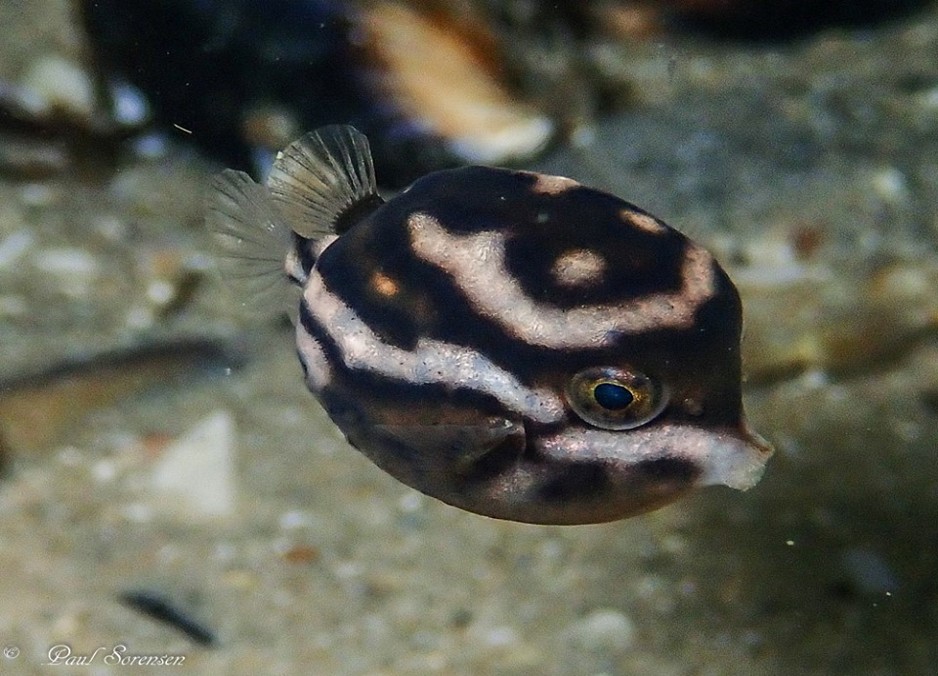
Scientific Name: Anoplocapros lenticularis (Richardson, 1841)
Common Name: White barred cow fish
References